|
Announcing the ...
|
Single-Switch Access to
Science Software
Project
|
A single-switch can be the key to
worlds of science and discovery.
|
Penny D. Matthews
Project Manager
Warren E. Lacefield
Principal Investigator
Academic Software, Inc.
3504 Tates Creek Road
Lexington, KY 40517
859-552-1020
|
Help us identify high-quality science education software for grades K-12 to adapt for children with disabilities.
INFORMATION RELEASE
Over a decade ago (in the early 2000's) Academic Software, Inc., (ASI) a small educational research and assistive technology firm in Lexington, KY, completed a Single-Switch Access to Science Software (SSASS) project, supported by NSF and the Kentucky Cabinet for Economic Development.
The SSASS project utilized WinSCAN - a multi-function, programmable single-switch interface for PC computers developed by ASI - in conjunction with high-quality science education software and science-related Internet sites to demonstrate that students with severe physical disabilities could utilize the same software and perform the same science activities in the classroom as do their peers without disabilities. These results remain just as relevant today, especially since WinSCAN 3.0 CS has now been released for modern computers with USB peripheral device interfaces running Windows 8 and 10.
Technology has become an essential tool in today's classrooms. More and more science teachers are using the Internet and innovative computer programs to enhance their own lesson plans. Commercially published science curricula now include programs like Windows on Science to supplement textbooks and other study materials. Such new and exciting science software, Internet access, and interactive study materials offer all students - and especially students with disabilities - hands-on access to the science curriculum.
Unfortunately such programs alone are not enough. Students with disabilities need appropriate tools to access the software package or Internet site and carry out the learning activities. A series of NSF research projects (Intellitools, Inc., 1994) demonstrated conclusively how students with disabilities who can use alternate keyboards can access educational software and achieve results comparable to their peers in the classroom. But what about many other children who are unable to use such keyboards or other high-technology assistive devices? What if they can only operate a switch? Are these children simply to sit on the sidelines, watching and being "warm bodies in the classroom?"
The Single-Switch Access to Science Software (SSASS) project demonstrated that students with severe physical disabilities who can use switches can utilize the same software and perform the same computer-related learning activities in the classroom as do their peers without disabilities, especially in the sciences and technologies.
To provide access, the SSASS project staff developed custom WinSCAN scanning display setups and detailed lesson plans for supplemental learning activities based upon well-known and widely utilized elementary science programs and popular exploratory Internet science sites. These include software such as A Field trip into the Sea (Sunburst Communications, Inc.), The Way Things Work (DK Multimedia), and Science Blaster, Jr., (Davidson & Associates) and places on the World Wide Web such as the NASA Space Shuttle Launch web site and Views of the Solar System from the Los Alamos National Labs. These materials were tested at six different field sites across the country by teachers and by elementary students with and without disabilities.
The results of this field-study (found here) can help guide planning for further development, field testing, and dissemination of adaptive methods to provide access to a broad range of supplemental science education curriculum materials for children and youth with disabilities.
| This material is based upon work supported by the National Science Foundation under award number DMI-9660571. Any opinions, findings, conclusions or recommendations expressed in this publication are those of the authors and do not necessarily reflect the views of the National Science Foundation.
|
|
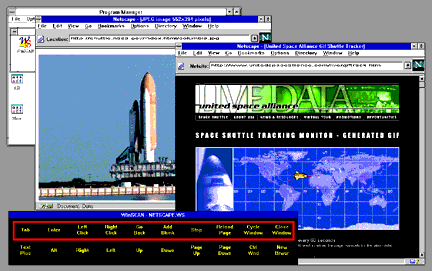
Access space shuttle science data in real time at NASA
via the Internet using a single-switch. |
 Return to the top of this page
 Return to the ASI home page
Copyright © 2016 Academic Software, Inc.
All Rights Reserved